

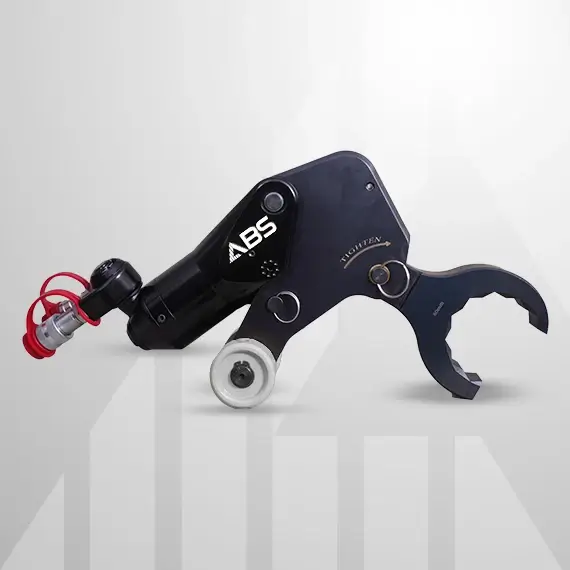
Specifications
- Minimum Torque (Nm / ft.lbs.) 329 / 243
- Maximum Torque (Nm / ft.lbs.) 11,045 / 8,146
Hydraulic Torque Wrench
A special ultra-thin hydraulic three in one Torque Wrenches
The CNO Series uses an ultra-thin cassette system for efficient operation in spaces where standard tools can’t fit. Its versatile cartridge supports open, closed, and ratchet spanners for precise bolting in tight areas. A unique roller-based reaction mechanism prevents scratches and dents on flange surfaces.
Features
- Ultra-Thin Design: Slim cassette allows access in tight spaces.
- Interchangeable Bits: Supports three spanner types for maximum versatility.
- Ring Spanners: Designed for 12-sided nuts.
- Open Spanners: Enables access to threaded rods in tight spaces.
- Ratchet Spanners: Allows quick and repeatable operation.
- Unique Reaction Mechanism: Roller design prevents surface and tool damage.
- Manoeuvrability: 360° × 180° hose swivel for improved handling.
- Global Compliance: CE certified for international safety standards.
Technical Data
CNO SERIES – Ultra-Thin Cassette System Specifications

Note: Minimum and maximum torque output data may vary by attachment and application.
Let's discuss further to get better results
Frequently Asked Questions
You will find answers to about our various industries and industry specialists service and more. Please feel
free to contact us if you don't get your question's answer in below.
free to contact us if you don't get your question's answer in below.
Choose the Correct Torque Range: Ensure the wrench’s range is appropriate for the application to avoid overloading or under-torquing. Calibrate Regularly- Follow the manufacturer’s recommendations for calibration to maintain accuracy over time. Apply Torque Evenly- Use smooth, steady pressure to prevent sudden impacts, which can cause inaccuracies. Don’t Over-Torque- Setting or using the wrench above its rated capacity can lead to tool damage and unreliable torque output. Reset After Use- For adjustable torque wrenches, return the setting to the lowest value after use to relieve spring tension and extend tool life. Inspect Before Each Use- Look for wear, damage, or rust, especially around the head and handle. Store Properly- Store in a clean, dry place, preferably in a protective case, to avoid wear and exposure to elements.
A hydraulic torque wrench applies controlled torque to a fastener using hydraulic pressure. It has a hydraulic pump that supplies pressurized fluid to a piston in the wrench. As the piston extends, it drives a reaction arm against an anchor point, which rotates the wrench head and fastener. This hydraulic force allows for highly controlled and powerful torque application, essential in heavy-duty applications like industrial assembly and maintenance.
Yes, hydraulic torque wrenches require regular calibration to ensure accuracy and reliability. Over time, mechanical wear, temperature fluctuations, and high usage can affect torque output, leading to potential errors. Regular calibration maintains the tool's accuracy within manufacturer specifications, ensuring safe and precise torque application. Calibration intervals are typically determined by usage frequency and application-criticality.
The capacity of a hydraulic torque wrench varies widely depending on the model. Generally, capacities can range from as low as 100 Nm (Newton-meters) to over 100,000 Nm. Wrenches with higher torque capacities are used in heavy industries like mining, power generation, and petrochemical sectors, while those with lower capacities are suited for lighter applications.