

Bolt Load Measurment
PMS Bolt Load Cell
Features
Overview of the PMS Bolt Load Cell
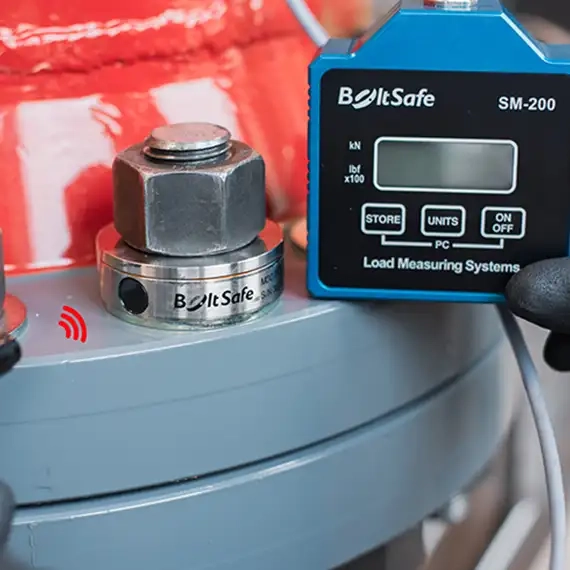
The BoltSafe PMS (Periodic Monitoring System) bolt load cell is a specialized sensor designed to periodically monitor bolt load in bolted joints. Using a handheld reader and probe, the PMS system enables real-time bolt load checks without the need for cables thanks to its non-contact inductive interface. This technology provides highly accurate bolt load readings, enhancing structural safety, reliability, and reducing installation and maintenance costs.
How the PMS Bolt Load Cell Works
Each PMS load sensor is built with an ASIC (Application-Specific Integrated Circuit) that manages signal processing and digital communication. Every load cell carries a unique serial number for tracking and identification. In addition to bolt load measurement, the system can also monitor sensor temperature to ensure precise evaluation of load conditions.
PMS load cells are available in both standard stainless steel and a high-strength variant—capable of handling 15% more load without increasing the device size.
Applications in Structural Health Monitoring
PMS load cells function like washers and are widely used in temporary constructions and structural health monitoring. They help verify load levels and prevent structural failure. Available in sizes ranging from M30 to M64 and 1-1/4” to 2-1/2”, the load cell is placed on the non-driven side of the bolted joint—preferably under a nut.
When tightened, the bolt applies force to the PMS washer, causing slight deformation. This deformation changes electrical resistance within the cell, which enables real-time load measurement—even in harsh environments exposed to oil, seawater, extreme weather, and temperatures between -40°C and 80°C. Each load cell is factory-calibrated and requires no recalibration if used as specified.
Advantages of Periodic Monitoring with PMS Load Cells
- Cable-free monitoring: The non-contact probe allows readings in confined or complex environments where wiring is impractical.
- Convenient multi-sensor monitoring: Users can check several load cells using the same handheld reader and probe.
- Large storage capacity: The handheld reader stores data from up to 256 PMS sensors.
- Accurate periodic load assessment: Ensures optimal preload conditions and prevents bolting failures.
- Enhanced structural safety: Ideal for bridges, towers, cranes, and heavy industrial structures requiring periodic integrity checks.
- Data analysis made simple: Measurement data can be transferred to a PC for review, reporting, and analysis.
Compatible Readout Methods for PMS Load Cells
The PMS system uses the SM-200 handheld reader together with the PMS probe to capture bolt load data. The probe uses an infrared-based non-contact inductive interface to power the sensor and retrieve its measurements.
- Handheld Reader: Used together with the PMS probe for instant bolt load readings.
- Infrared Probe: Transfers power and reads data from the load cell through non-contact induction.
- USB Connectivity: Measurements stored in the handheld reader can be transferred to a PC using BoltSafe “Report Generator” software.
After Sales Support
We are committed to supporting you even after your PMS Bolt Load Cell purchase. For technical inquiries or assistance, feel free to reach out to us at 828282-9795 or write to marketing@absgroup.in.
Our global presence ensures you receive prompt guidance and complete access to BoltSafe solutions anywhere in the world. We're here to assist you every step of the way.
Technical Data
Let's discuss further to get better results
Frequently Asked Questions
free to contact us if you don't get your question's answer in below.