

Specifications
- Maximum Torque (Nm) / (ft-lbs) 15000 / 11000
- Minimum Torque (Nm) / (ft-lbs) 70 / 50
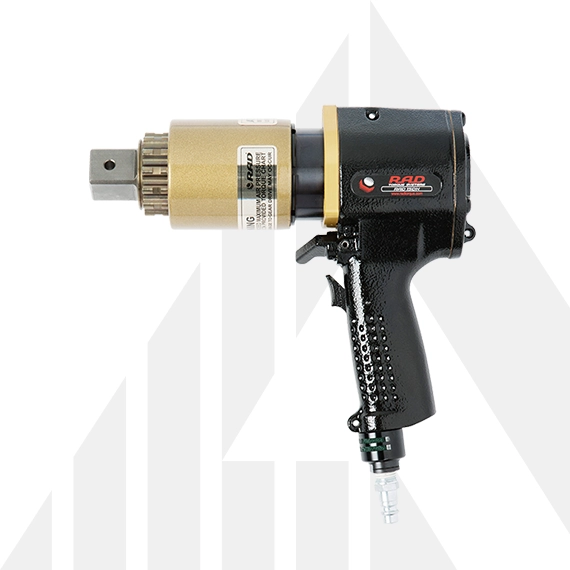
Pneumatic Torque Wrench
RAD Single Speed
The RAD Single Speed Pneumatic Torque Wrench is built for heavy-duty industrial bolting, offering unmatched power and reliability. With advanced planetary gearbox technology and the highest power-to-weight ratio, it ensures efficient, safe, and precise performance worldwide.
Features
- Ultimate Power-to-Weight Ratio: Delivers superior performance with easy handling.
- Precision Gearbox: Advanced and reliable torque output.
- Controlled Accuracy: Precise bolting with ±4% accuracy.
- Vibration-Free Operation: Smooth, zero-vibration tightening.
- Included FRL Unit & Holder: Complete kit supplied with FRL unit.
- ISO 17025 Calibrated: Certified to meet global calibration standards.
Technical Data
The RAD Single Speed series covers a large torque range and is known for its low noise operation.
Let's discuss further to get better results
Frequently Asked Questions
You will find answers to about our various industries and industry specialists service and more. Please feel
free to contact us if you don't get your question's answer in below.
free to contact us if you don't get your question's answer in below.
A pneumatic torque wrench operates on the principle of compressed air energy. Here's how it works- Compressed Air Supply: Air is supplied to the wrench through an air compressor. Motor Activation: The air drives a motor, which generates rotational force. Gear Mechanism: The force is transmitted through a gear reduction system to increase torque output. Torque Control: The tool allows the user to set a precise torque value, and the wrench automatically stops or disengages when the desired torque is achieved. This design provides consistent and controlled torque application, making it ideal for high-precision tasks.
The primary advantage of a pneumatic torque wrench is its ability to deliver high torque output with precision and consistency, even in industrial applications. Other key benefits include: Continuous Operation: Suitable for prolonged use without overheating. Lightweight Design: Easier to handle compared to hydraulic tools. Safety: Reduces operator fatigue and minimizes the risk of over-tightening. Efficiency: Speeds up bolting tasks with minimal physical effort.
Torque wrenches have the following limitations: Calibration Dependency: They require regular calibration to maintain accuracy. Limited Range: Each wrench has a specific torque range, and using it beyond this can damage the tool or affect accuracy. Operator Dependency: Improper use, such as applying additional force after the ""click"" on a mechanical torque wrench, can result in over-tightening. Cost: Advanced digital or pneumatic models can be expensive.
A fundamental rule is to never exceed the torque wrench's specified range. Additional guidelines include: Set the Correct Torque: Always adjust the wrench to the required torque value for the application. Use Smooth Motion: Apply torque in a steady and even manner. Avoid Misuse: Do not use the wrench as a breaker bar or hammer. Store Properly: Reset the wrench to its lowest setting after use to avoid spring tension damage in mechanical models.