

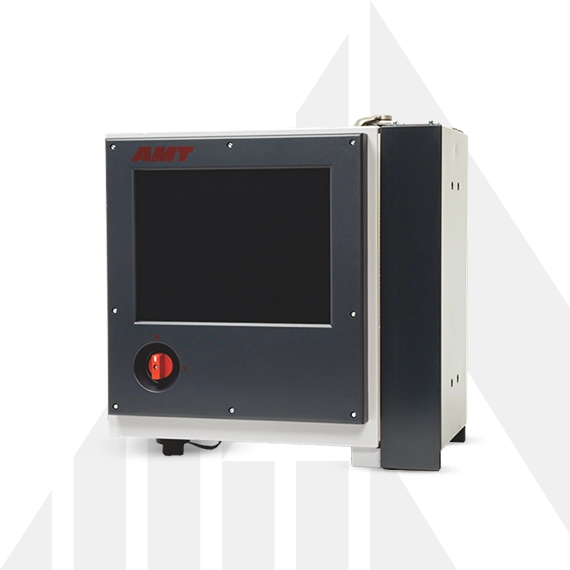
Controller
The Core of Intelligent Assembly Systems
AMT SMX Controllers are the intelligent core of high-precision fastening systems, built on a scalable hardware platform with new control software to meet Industry 4.0 and multi-channel assembly demands
Features
- Scalable Architecture: Easily expands to support growing production needs.
- Digital Communication: Seamless data exchange with connected tools and systems.
- Integrated Safety: Built-in safety features ensure secure operation.
- Intuitive: User-friendly interface for fast and easy operation.
- Periphery Integration: Connects with external devices and accessories.
- Software Management: Centralized configuration, monitoring, and reporting.
- Multi-Tool Capability: Supports and controls multiple tools from one unit.
Technical Data
The SMX series offers a robust, scalable solution, allowing you to tailor the control unit precisely to your production needs:
Let's discuss further to get better results
Frequently Asked Questions
You will find answers to about our various industries and industry specialists service and more. Please feel
free to contact us if you don't get your question's answer in below.
free to contact us if you don't get your question's answer in below.
Yes, training is generally required to operate a Nutrunner Controller System. While some controllers are user-friendly and come with intuitive interfaces, understanding how to set up, calibrate, and monitor torque values effectively requires knowledge of the system. Proper training ensures that operators can use the tool safely and efficiently, preventing mistakes such as applying too much or too little torque, which could damage the fasteners or cause structural failure. Training also helps in optimizing the performance of the system and troubleshooting common issues.
A torque controller is a device used to regulate and monitor the amount of torque being applied by a torque tool (such as a nutrunner or torque wrench). It ensures that the fastener is tightened to the desired torque setting, typically based on manufacturer specifications or quality standards. The controller may feature settings for different torque ranges, visual or auditory indicators to alert the operator when the target torque has been reached, and safety features to prevent over-tightening. It plays a crucial role in ensuring the accuracy, consistency, and safety of bolting operations.
The working principle of a torque wrench is based on a mechanical or electronic system that measures the amount of rotational force (torque) applied to a fastener. When the torque wrench is used to tighten a bolt or nut, the internal mechanism (such as a spring, dial, or electronic sensor) detects the amount of force being applied. Once the preset torque value is reached, the wrench either clicks (in the case of a mechanical torque wrench) or displays an alert (in the case of a digital wrench), signaling to the operator that the desired torque has been achieved. This helps ensure that the fastener is tightened correctly without being over or under-tightened.
The function of a torque tool is to apply a specific amount of torque to a fastener, such as a bolt or nut, ensuring it is tightened to the correct specification. Torque tools are essential for ensuring the structural integrity and safety of bolted joints in various industries, including automotive, construction, aerospace, and manufacturing. They are used to prevent damage to fasteners and components, avoid over-tightening (which can cause material damage or deformation), and ensure that the correct tension is applied for proper joint performance. Torque tools can be manual (like a torque wrench) or powered (like an electric or pneumatic nutrunner).